
During pregnancy
Fetal movements and kicks
After pregnancy week 18 to 20, most pregnant women will start to feel their baby moving and kicking daily. You will gradually get to know your baby's rhythm and periods of activity.
Some fetuses are more active at certain times of the day. Others react with kicking and activity to loud noises, or when the mother is active or has just eaten.
From pregnancy week 28, you should feel the baby moving or kicking multiple times during the day. The baby's rhythm and activity pattern are now more distinct. It is not unusual to need to relax to feel clear movements from the baby.
As your stomach grows and there is less room for the baby to move around inside the womb. You will feel then your baby’s movements in a different way than earlier in your pregnancy, but you should still regularly feel your baby moving.
Get help to monitor your baby’s movements at kjennliv.no
Be attentive
If you are unsure whether the baby is moving, or if you haven't felt any activity for a while, you can try to stimulate movement. Do something you know usually wakes the baby, such as playing music or having a cold, sweet drink. If you have been busy, sit down and try to relax. It is easier to feel kicks when you are resting. Pay attention to the response you get. Strong kicks and movements are a sign that the baby is doing well.
If you do not get the expected response from the baby, you should contact the maternity unit for further assessment and a check-up.
Fetal monitoring during childbirth
There are various ways in which midwives and doctors can monitor how well your baby is doing both before and during birth.
The extent of fetal monitoring during birth will depend on
- how your pregnancy has been
- whether you and your baby are healthy
- whether everything is set for a normal birth
- whether there are any factors relating to you or your baby which will require additional monitoring.
Fetal sound
In connection with childbirth, midwives and doctors refer to the baby’s heart rate as the fetal heart sound. The fetal heart sound is specified as frequency and regularity. The fetal heart sound will normally vary between 110 and 150 beats per minute.
The fetal heart sound, combined with information about the amniotic fluid (once your waters have broken) will provide important information on how your baby is doing and how it is coping with birth.
The fetal heart sound will give the obstetrician a good indication of the baby’s health during the birth.
The midwife will listen to the fetal heart sound throughout the birth. Towards the end of the birth, when the baby is passing through the narrowest part of the birth canal, the midwife will listen more frequently than at the start of the birth. The final stage of the birth process is the most strenuous for the baby.
Doppler fetal monitor
A Doppler fetal monitor is an electronic device which is used to listen to the baby's heart rate (fetal heart sound). Doppler fetal monitor is an electronic device with a speaker which enables the fetal heart sound to be heard by everyone in the room.
If the midwife or doctor is unsure or picks up signs that the baby is struggling a little, the baby will be monitored over an extended period. If appropriate the baby may be continuously monitored throughout the entire labour.
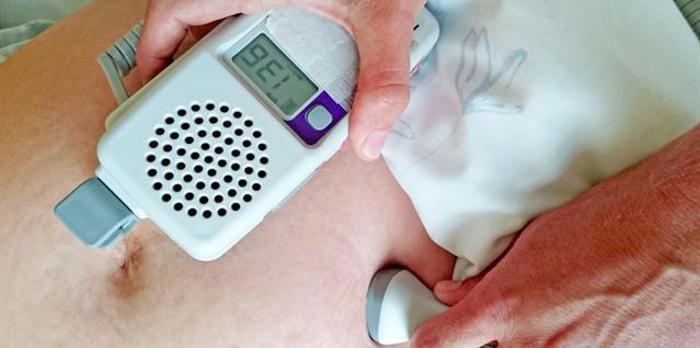
Illustration: Haukeland universitetssjukehus
Cardiotocography (CTG)
CTG is an electronic monitoring of the baby’s heartbeat. This monitoring tracks the baby's heartbeat and the frequency of contractions. This will provide a good picture of how your baby is doing and how well it will be able to cope with the birth.
In the case of CTG monitoring, two electrodes (transducers) will be placed on your stomach and held in place by an elastic belt. One will record the baby’s heart rate; the other will record the contractions. Both the heartbeat and the contractions which are recorded will be shown on a display on the CTG device and can be printed out.
The child's kicks and movements can also be recorded. This can be done either by the device itself or by you pressing a button every time you feel the baby move.
If the baby shows signs of distress or is likely to struggle during the birth, the baby will be monitored continually. Examples of this include birth following pregnancy with complications or illness in the mother or child.
CTG is used for fetal monitoring at all Norwegian hospitals. If additional information is needed on how the baby is doing, further information can be obtained using STAN monitoring or by measuring scalp lactate.
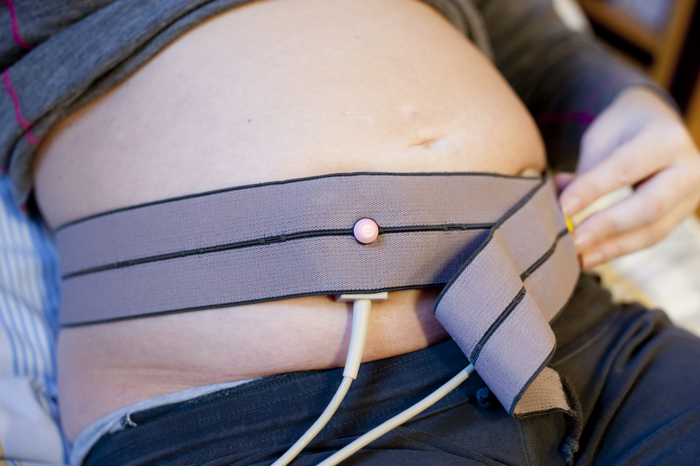
Illustration: Haukeland universitetssjukehus
STAN – fetal monitoring
This method was developed to identify children who are exposed to oxygen deficiency in the heart muscle cells during birth. The method provides more information about the baby's health than CTG on its own. STAN is a fetal monitoring method which is used in connection with high-risk births which reach full term. Wit STAN, an electrode is attached to the fetal head during a vaginal examination. This feels like a small prick.
STAN is used during active birth to analyse the baby's ECG (electrocardiogram), in addition to CTG. ECG is a method for assessing the function of the heart.
While CTG detects the baby’s heart rate and its fluctuations, STAN analysis provides information on the aspects of the baby’s ECG which will change in the event of oxygen deficiency. These aspects of the ECG are known as ‘ST’, which is why the method is referred to as ‘STAN’ (ST-ANalysis).
Lactate measurement
In some hospitals, lactate measurement is also used as part of fetal monitoring. The obstetrician then takes a small blood sample from the child's scalp during birth. This is done to obtain more information about the condition of the fetus during birth.
Pinard stethoscope
A pinard stethoscope is a hollow wooden tube which is placed on your stomach, immediately over the area where your baby’s heartbeat is clearest. Using a pinard stethoscope, the midwife or doctor can listen to your baby’s heart rate/pulse.

Illustration: Haukeland universitetssjukehus
Once your baby is born
The midwife or doctor will continually inform you about your child's health. Once your baby has been born, a blood sample will sometimes be taken from the umbilical cord. This sample will be analysed because it can give an indication as to whether the baby was exposed to oxygen deficiency during the birth.

Newborn screening and examination
All parents are offered medical examinations of their newborn baby to detect any anomalies or congenital disorders.
Illustration: Irina Schmidt / Mostphotos