What is prenatal testing?
Prenatal tests and examinations of the fetus can provide information on the health of a fetus. The tests and examinations can provide information about fetal development, fetal DNA and whether the fetus may have any particular diseases or developmental disorders.
Prenatal testing often involves a combination of several different examinations.
Prenatal testing is voluntary. You decide whether or not to accept the offer of prenatal testing and examinations.
If you would like prenatal testing, you should contact your midwife or GP early in your pregnancy. They will then be able to provide you with more information about the service. You will need a referral to access pre-natal testing in the public health service.
Different pre-natal examinations
Early ultrasound examination offered in pregnancy week 11 to 14
All pregnant women are offered an ultrasound examination in weeks 11 to 14 of the pregnancy. This service is available in all health regions and is provided free of charge by the public health service. Most women will be offered the service at their local hospital. You will receive more information about the examination at your first appointment with the midwife or GP.
NIPT if you are over the age of 35
Pregnant women who will be 35 years or older at term will be offered NIPT when they come for their ultrasound examination in week 11 to 14. This also applies to pregnant women for whom the test is medically indicated. NIPT is available free of charge to these groups.
NIPT for women under the age of 35
Public hospitals may offer NIPT to pregnant women who are under the age of 35 for a fee, which is currently 6,000 NOK. Also in these cases, the blood sample will be obtained at the ultrasound examination performed in week 11 to 14.
This offer will be gradually introduced across the four health regions. The service has been available at hospitals in the South-Eastern Norway Regional Health Authority since 1 September 2025 and in the Western Norway Regional Health Authority since 1 January 2026.
Pregnant women can also pay for NIPT at an authorised private clinic. Referral will not be necessary in this case.
Other pre-natal examinations
Pregnant women with a special indication may be offered other pre-natal examinations through the public health service. These are also free of charge.
Prenatal examinations for pregnant women with special indications
Some pregnant women will be offered relevant genetic fetal diagnostics or ultrasound examinations at a centre for fetal medicine. This may be relevant if:
- an ultrasound examination shows that the fetus may have a developmental anomaly, or NIPT indicates that the fetus may have a trisomy.
- you have an increased risk of having a fetus or child with a serious developmental anomaly, serious congenital disease and some other very serious hereditary disorders.
- you have previously had a fetus or child with a serious disease or developmental anomaly.
You can be referred to a centre for fetal medicine/department of medical genetics by the primary health service or your local hospital.
If you and your partner are facing an extremely challenging life situation and are unable to manage the stress of having a child with a serious disease or disorder, NIPT via the specialist health service can be offered free of charge. In such cases, a blood sample for NIPT will be taken when you come for an ultrasound examination at your local hospital in pregnancy week 11 to 14.
Early ultrasound examination in pregnancy week 11 to 14
During the ultrasound examination in week 11 to 14, the midwife or doctor will check vitality, determine the length of the pregnancy and examine the entire body of the fetus (head, arms, legs, abdomen, etc.). The examination provides information about fetal development, among other things. Most scans show that the development of the fetus is normal.
The early ultrasound examination will reveal whether there is one or more fetuses. If you are carrying twins, it is important to check whether they have a shared placenta. Twins who share a placenta require special care.
The ultrasound examination may provide early information about some serious diseases and developmental anomalies in the fetus. It can also provide information about diseases that require special care for you and/or the fetus.
The ultrasound examination will be performed at your local hospital, free of charge. No private clinics have so far received authorisation to perform this examination.
About the examination
The examination is normally performed using an ultrasonic probe on the abdomen, although a vaginal ultrasound can sometimes provide a clearer picture.
The examination does not hurt and is not harmful to the fetus. The examination, including information from the midwife or doctor, will take around 45 minutes.
If the ultrasound scan indicates that the fetus may have a developmental anomaly, you will be offered further examinations, usually at a centre for fetal medicine. It may sometimes also be necessary to perform chorionic villus sampling or amniocentesis.
Nuchal translucency (NT) scan
Between weeks 11 and 14 of the pregnancy, all fetuses have a small fluid-filled space on their neck – a nuchal translucency. If the nuchal translucency is larger than expected the midwife or doctor who is doing the ultrasound examination can measure its size.
An enlarged nuchal translucency may indicate that the fetus has a chromosome disorder, such as trisomy 13, 18 or 21. Trisomy means that there is an extra copy of the chromosome.
The likelihood of trisomy 13, 18 and 21 can be estimated based on the size of the nuchal translucency, combined with other information about you and the fetus.
The most common of these disorders is trisomy 21, which is also known as Down’s syndrome.
Enlarged nuchal translucency can also indicate other disorders in the fetus, such as heart anomalies or other genetic disorders. The fetus may be completely healthy even if the examination shows an enlarged nuchal translucency.
NIPT for trisomy 13, 18 and 21
NIPT (Non-Invasive Prenatal Testing) refers to the analysis of blood samples taken from a pregnant woman to obtain information about the fetus.
All pregnant women have DNA (genetic material) from the placenta in their bloodstream. By analysing this DNA in a blood-sample, it is possible to obtain information about the probability of chromosomal disorders in the fetus. The test is risk-free for you and the fetus.
NIPT is used to examine whether a fetus has an increased risk of specific chromosome disorders:
- trisomy 13 - (Patau’s syndrome)
- trisomy 18 - (Edwards’ syndrome)
- trisomy 21 - (Down’s syndrome trisomy)
The most common of these is trisomy 21, also known as Down’s syndrome. Trisomy 13 and trisomy 18 are less common than trisomy 21.
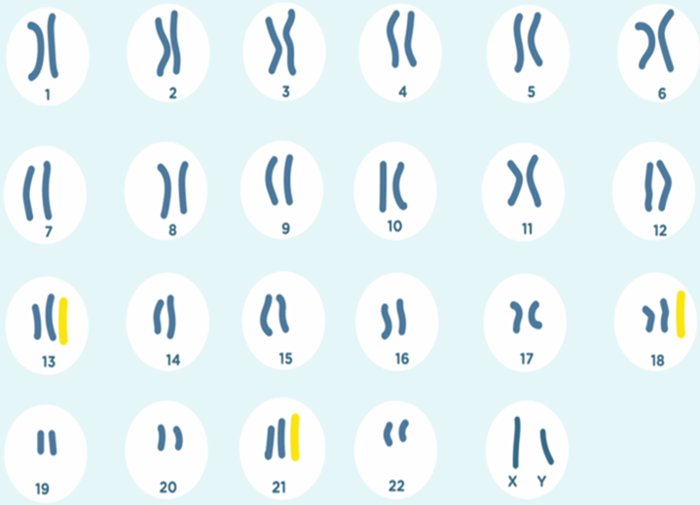
Trisomy refers to a change in the number of chromosomes. The NIPT test can show whether the foetus has an increased risk of trisomy 13, 18 or 21, i.e. an extra copy of chromosome 13, 18 or 21.
Figure 1 shows an overview of the chromosomes with two copies of each chromosome (1 to 22) and two sex chromosomes (X and Y in males or X and X in females).
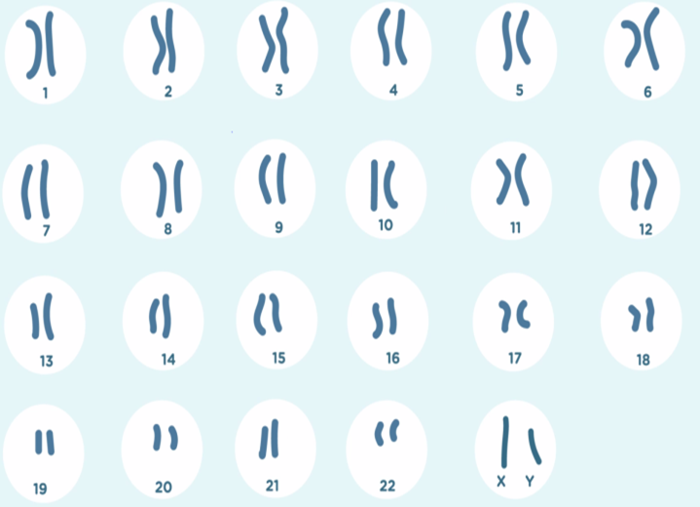
Figure 2 shows an extra copy (trisomy) of chromosome 13, 18 or 21. The extra copies are illustrated in yellow.
NIPT is not a diagnostic test, even though it has a high probability of detecting an increased risk of trisomy. NIPT is the most accurate for detecting a risk for trisomy 21. In some cases, the test can provide a false result.
NIPT cannot be performed to obtain information about fetal sex (the exception being NIPT for hereditary disorders linked to the X-chromosome).
Who is offered NIPT?
NIPT in the public healthcare
Pregnant women who will be 35 years or older at term and pregnant women with a special indication will be offered NIPT free of charge at an authorised public hospital.
Pregnant women under the age of 35 who do not have any indication for pre-natal testing can have a NIPT test at their own expense. The test costs NOK 6,000.
In the public specialist healthcare services, blood samples for NIPT are obtained when you have the ultrasound examination in week 11 to 14.
Only clinics authorised by the Norwegian Directorate of Health are permitted to offer NIPT. The sample will be sent to a laboratory, which will do the analysis.
Private NIPT
Authorised private e clinics may offer NIPT after week 10+0 of pregnancy. The test cannot be performed any earlier.
You will have to pay for the examination yourself.
Before the blood-sample is obtained, the midwife or gynaecologist will do a simple ultrasound examination to check the vitality of the fetus, determine the number of fetuses and the age of the fetus. This information is important for the analysis of the sample.
Private clinics use laboratories abroad (Nordic region/EU or USA) for the analysis. The Norwegian Directorate of Health requires laboratories to comply with European data protection requirements. Laboratories are not permitted to use material or data that they receive for purposes other than NIPT analysis for trisomy 13, 18 and 21.
How long does it take to get the test results?
The clinic will tell you how long it takes to get your test results. You will be notified in the manner agreed between you and your doctor/midwife.
The midwife or doctor will explain the results, the reliability of the test results, and whether further testing may(?) be necessary.
In most cases, NIPT will not provide any indication of trisomy in the fetus, and no further testing will be necessary.
What happens next if the NIPT results show a high probability of trisomy?
In some cases, NIPT may indicate an increased probability of the fetus having a trisomy. Further tests and examinations will then be recommended, such as additional ultrasound examinations, chorionic villus sampling or amniocentesis.
You will be offered further follow-up at a centre for fetal medicine. Hospitals or clinics that offer NIPT have procedures for referring pregnant women for further examinations at a centre for fetal medicine.
NIPT for hereditary disorders linked to the X-chromosome
X-linked disorders are primarily caused by genetic mutations in the X-chromosome.
You may be offered NIPT if there is an increased risk of having a child with a serious, hereditary X-linked disorder which affects boys. In such cases, NIPT will be performed to determine the sex of the fetus. If both boys and girls are affected, it is more relevant to analyse the genetic mutation through chorionic villus sampling or amniocentesis.
You will often already be aware of the risk of X-linked disorders and will have received genetic counselling prior to pregnancy. If not, you should be referred for such counselling.
In order to be offered NIPT to determine the sex of the fetus, the midwife or doctor must refer you to a department of medical genetics or centre for fetal medicine.
The test is highly accurate in determining the sex of the fetus, but it cannot show whether or not the future child will develop the disorder.
If the fetus is a boy, you will therefore be offered chorionic villus sampling or amniocentesis to check whether the fetus carries the genetic mutation concerned. Chorionic villus sampling or amniocentesis will provide an accurate result.
If the fetus is female, further testing will not be necessary.
Chorionic villus sampling (CVS)
If you have a CVS, a tiny sample of tissue from the placenta (placental tissue) is tested. The sample contains cells from the fetus, and therefore genetic information (DNA). The placenta develops from the fertilised egg. The genetic material of the placenta is therefore (normally) the same as in the fetus.
Chorionic villus sampling will reveal whether the fetus has a congenital or hereditary disorder or disease. Trisomy 13, 18 or 21 are examples of congenital disorders.
Who is offered chorionic villus sampling?
You may be offered chorionic villus sampling if:
- there is an increased risk of the fetus having a serious hereditary disorder or disease
- ultrasound examination has identified fetal anomalies
- in some cases, when NIPT shows a high probability of trisomy
In order to undergo chorionic villus sampling, you will need to be referred to a department of medical genetics or centre for fetal medicine. You will be given guidance and information about the examination beforehand.
Chorionic villus sampling can be carried out after week 11 of your pregnancy, normally between weeks 11 and 14.
What does chorionic villus sampling involve?
Chorionic villus sampling can be performed in one of two ways:
- through the abdominal wall (transabdominally)
- via the vagina through the cervix (transcervically)
An ultrasound examination is performed to determine the best method. This will depend on the position of the placenta.
Under ultrasonic guidance, a needle will be inserted through the abdominal wall and into the placenta. A small amount of tissue will then be extracted from the placenta.
Alternatively, a small clip/cannula can be inserted via the cervix into the placenta to extract the tissue.
Sample collection can be a little painful. Pain is experienced differently, but for most women, the pain resembles that experienced during a cervical smear.
After the sample has been taken, it is recommended that you wait around 15 minutes before leaving the hospital. You may also be advised to avoid any strenuous activity for two to three days after the examination. Normally, you will not need sick leave.
How long does it take to get the test results?
The time needed to get your test results will depend on what you are being tested for.
You will be informed about the expected time when you receive genetic counselling or when the sample is taken. The results will be sent to your secure digital mailbox/by mail or communicated over the phone.
In around two per cent of cases, chorionic villus sampling does not provide an absolutely certain result or diagnosis, and it may therefore be necessary to verify the results using amniocentesis.
Are there any risks associated with the examination?
Between 0.2 and 0.5 per cent of those who undergo chorionic villus sampling may develop complications as a result of the sampling, including miscarriage. Miscarriages will usually occur within the first week after sampling.
Amniocentesis
If you have an amniocentesis, a small amount of amniotic fluid (the water around your fetus inside your uterus) for testing. The sample contains some of the baby’s cells, which contain genetic information. Amniocentesis will reveal whether the fetus has a congenital or serious disorder/disease. Trisomy 13, 18 or 21 are examples of congenital disorders.
Amniocentesis is performed later in the pregnancy than chorionic villus sampling, after week 15 of pregnancy.
Who is offered amniocentesis?
You may be offered amniocentesis if:
- there is an increased risk of the fetus having a serious hereditary disorder or disease
- fetal anomalies have been identified during ultrasound examination
- NIPT shows a high probability of trisomy in the fetus
In order to undergo amniocentesis, you will need to be referred to a department of medical genetics or centre for fetal medicine. You will be given guidance and information about the examination beforehand.
How is amniocentesis performed?
Before the amniocentesis is performed, an ultrasound examination will be performed to determine the size of the fetus, the position of the placenta and the best place to insert the needle.
Under ultrasonic guidance, a thin needle will be inserted into your uterus (uterine cavity). Approximately 15 ml or more of amniotic fluid will be extracted, depending on indication and the genetic analysis. This may be a little painful, a bit like a normal blood test.
After the sample has been taken, it is recommended that you wait around 15 minutes before leaving the hospital. You may also be advised to avoid any strenuous activity for two to three days after the examination. Normally, you will not need sick leave.
How long does it take to get the test results?
The time needed to get your test results will depend on what you are being tested for. Some analyses take longer.
You will be informed about the expected time when you receive genetic counselling or when the sample is taken. The results will be communicated over the phone or sent to your secure digital mailbox/ by mail.
Are there any risks associated with amniocentesis?
Between 0.1 and 0.5 per cent of pregnant women who undergo amniocentesis may develop a complication as a result of the sampling, including miscarriage. Miscarriages will usually occur within the first week after sampling.
Before and after pre-natal testing
Right to information
Ideally, you should seek information about pre-natal testing before your first pregnancy-related consultations with a midwife or doctor. This will make it easier for you to ask questions.
Your midwife or GP will provide you with neutral information about pre-natal testing and will be able to answer any questions you may have. This will enable you to make the decisions about fetal diagnostics that feels right for you.
If you need an interpreter, you should inform about this when you book the appointment.
If you decide to undergo pre-natal testing, you will need to give your written consent to the examinations that will be performed.
Prior to your examination at the local hospital, you will be given further information about the test or examination. You should receive information about:
- what will happen during the examination
- what the examination may reveal
- the possibility of unexpected findings
- how and how soon you will get the results
- what will happen next if the examination shows that the fetus has a disorder or disease, and the possible consequences
When you have the results
If the examination shows that the fetus may have a disease or developmental anomaly, you may be referred to a centre for fetal medicine, where you will receive further information about:
- whether more examinations will be necessary to obtain a (reliable) diagnosis
- the disorder or disease concerned and the expected prognosis
- your rights, follow-up and available support
Diagnostic testing is recommended if NIPT shows that the fetus could have trisomy 13, 18 or 21.
Dilemmas may arise
We recommend that you reflect on the consequences of prenatal testing and the possible dilemmas that you may need to consider. Although most fetuses are healthy, some pregnant women receive unexpected information about the fetus, for example that the fetus has an increased risk of disease, or a minor or even major developmental disorder. This could present you with difficult choices regarding the pregnancy.
Like many other examinations, prenatal testing and examinations may provide inconclusive results that require further examination in order to reach a definite answer. The waiting can be stressful. The prognosis can sometimes remain uncertain even after an examination has been performed.